
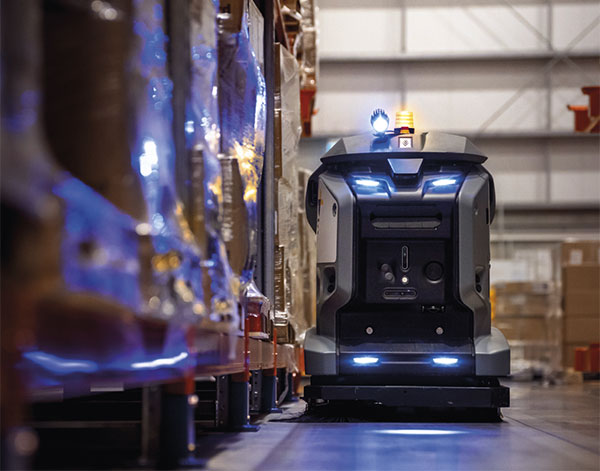
In an era of tightening health and safety requirements and rising supply chain demands, warehouse cleaning is shifting from a manual task to a measurable operational function. For New Zealand warehouse managers, the focus is no longer just on whether a machine cleans, but whether it can do so safely and consistently in high-traffic environments.
Kärcher’s KIRA B 50 (Kärcher Intelligent Robotic Applications) is positioned as more than a conventional scrubber, offering a certified autonomous system built to IEC 63327 standards and designed for logistics environments with public traffic.
The unit is engineered as a fully autonomous system, performing a 550mm-wide scrub using a 1200 RPM roller brush. With brush pressure rated at 80 g/cm², it is designed to remove fine industrial dust from sealed concrete surfaces in a single pass.
“It’s built from the ground up as an autonomous machine, not a bolt-on system. That gives it the precision and consistency needed for busy warehouse floors,” says Nathan Briggs, head of product Oceania.
Unlike hybrid systems, the KIRA B 50 incorporates a multi-sensor array, including 360-degree LiDAR and acoustic sensors. The system is programmed to detect pallet overhangs and protruding stock, reducing the risk of contact with racking and stored goods.
“With palletised environments, detection is critical. The machine is designed to recognise those real-world variables and operate safely within them,” says Briggs.
Operating at speeds of up to 4.3 km/h in autonomous mode, and equipped with visual warning beacons, the unit is designed to integrate into existing floor traffic without requiring dedicated “robot-only” zones.
Beyond cleaning performance, the system is also positioned around compliance and reporting. Kärcher says the KIRA B 50 replaces manual record-keeping with automated digital reporting, providing time-stamped audit trails through a web-based portal.
“Managers can verify exactly when and where cleaning has taken place. That removes the uncertainty of manual logs and supports audit requirements,” says Briggs.
Internationally, the system has delivered measurable labour savings. At DB Schenker’s Stuttgart facility, manual cleaning time was reduced from 90 minutes to 15 minutes. In New Zealand, Healthcare Logistics increased cleaning frequency by 150% across a 13,000 m² site using the system.
The KIRA B 50 is also designed to address operational usability. An onboard HD touch display allows supervisors to manage routes and settings without specialist software knowledge, while an optional docking station enables automated water emptying, refilling and battery charging for the 160 Ah lithium-ion system.
“Ease of use is critical. It needs to work for the people on site, not require additional technical overhead,” says Briggs.
Kärcher says the system allows warehouse operators to redirect labour from routine cleaning to higher-value tasks, while maintaining consistent cleaning standards.
With more than 35 service partners across New Zealand, the company says local support is readily available to maintain uptime and performance.