
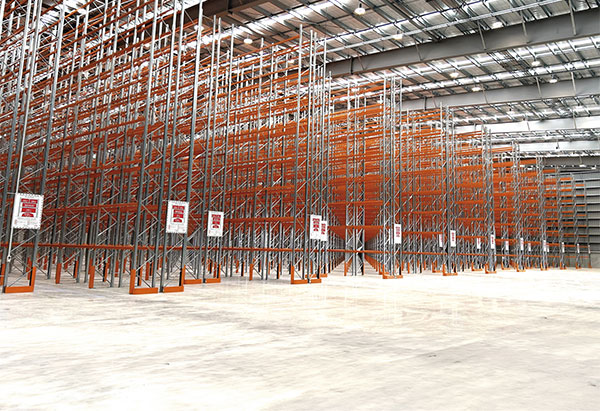
Storage racking systems are increasingly being installed in regions with high earthquake risk, yet they remain vulnerable to collapse, as seen in recent seismic events. Traditional solutions such as base isolation techniques are often expensive or limit functionality.
To address this, Dexion has developed an earthquake-resistant baseplate, the Friction Slipper Baseplate, designed to manage the seismic demand of pallet racking systems. The company says the baseplate “has demonstrated excellent performance through extensive experimental studies”, from component tests through to full-scale shaking table testing, and is comparable in cost to standard, non-seismic baseplates.
The scale of the issue is significant. Around 40% of all goods are stored on racks at some point during the manufacture-to-consumption logistics cycle, with goods worth USD 16.5 billion stored on cold-formed steel racking systems in seismically active regions worldwide in 2017 alone.
“These racks are highly susceptible to collapse during major earthquakes,” Jeff Darby, national sales manager. In the 2010–2011 Christchurch earthquakes, approximately NZD100 million worth of goods stored on pallet racks were lost, with even greater losses resulting from supply chain disruption. Similarly, during the 2011 Tōhoku earthquake in Japan, the loss of stored goods severely affected international supply chains, particularly in vehicle manufacturing.
The development of the globally patented product originated from PhD research conducted by Dr Zhenghao Tang, now director of research and development at Dexion New Zealand. Dexion says the product was first implemented in a commercial project in 2018, marking the beginning of its practical use.
“Today, about one-third of Dexion storage racking systems in New Zealand are equipped with the Friction Slipper Baseplate,” says Darby, highlighting what it describes as strong market demand for safer and more efficient seismic solutions.
Projects that have adopted the system include EastPack’s Te Puke cool store, described as the world’s first fully automated kiwifruit cool store, Crown Wellington’s document storage facility, and Wineworks’ Blenheim warehouse, each designed to meet stringent seismic performance requirements.
Instead of a rigid connection, we integrated the Friction Slipper Baseplate at the base of the upright columns. This specialised baseplate allows the column bases to undergo a controlled, calculated frictional displacement during severe seismic shaking.”
The company says this mechanism acts as an energy dissipater, reducing the forces transferred into the steel structure above.
“The sliding action creates friction, which safely dissipates the destructive energy of the earthquake as heat,” says Tang.
In automated warehouse environments, where robotic cranes run on tracks attached to racking systems, even minor deformation can result in significant downtime. Dexion says the system helps prevent this, protecting both stored goods and automated infrastructure.
“It provides a level of seismic resilience superior to conventional designs, without requiring massively oversized steel columns,” says Tang, adding that the approach supports both cost control and performance.
The system also supports business continuity, with the main racking structure remaining largely undamaged after a seismic event.
“After a major earthquake, the racks simply require a standard inspection and minor maintenance, allowing the warehouse to resume operations almost immediately.
“The Friction Slipper Baseplate demonstrates that seismic resilience can be achieved without added cost or complexity, with adoption continuing to grow across New Zealand.”
Sponsored content: For more information phone 0800 339 466.