
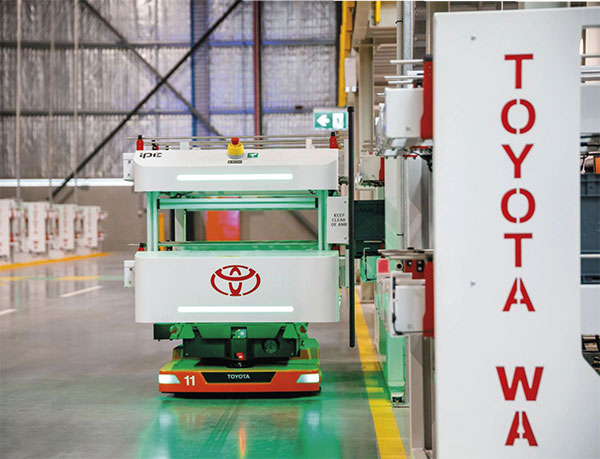
Toyota brings automation businesses together under unified structure
Toyota Industries Corporation’s decision to bring its warehouse automation activities together under the Toyota Automated Logistics structure marks a significant development in the evolution of intralogistics globally, and in how automation capability will be delivered into markets such as New Zealand.
The reorganisation, which came into effect on April 1, 2026, brings together established automation providers including Vanderlande, viastore and Bastian Solutions under a single structure. Each of these businesses has built strong positions in different areas of warehouse automation, and the alignment signals a move toward a more integrated approach across distribution, storage, robotics and software.
Over many years, the Toyota Industries Group has developed its automation capability through these organisations. Vanderlande has been closely associated with high-throughput sortation and goods-to-person systems, viastore with storage and pallet handling, and Bastian Solutions with flexible automation and system integration. Each has contributed to the development of a broad and technically capable portfolio across the global market.
The new structure brings these complementary strengths closer together under Toyota Automated Logistics, creating a more unified organisation with the ability to draw on a wider combination of technologies and engineering expertise.
For customers, the change represents a shift from engaging with individual capabilities in isolation to accessing a more integrated set of solutions. The combined organisation is positioned to deliver across a broader spectrum of project sizes and complexity, from large-scale distribution centre automation through to smaller, staged implementations.
“This change is really about what it unlocks for our customers. We are no longer bringing individual technologies to the table, but a much more connected and complete capability across sortation, storage, robotics and software,” says Roald de Groot of Toyota Automated Logistics.
“That allows us to support a broader range of projects, from large-scale distribution centres through to more targeted automation initiatives. Ultimately, it strengthens our ability to grow alongside our customers and support them over the long term. As part of the Toyota Group we want to join a customer on their journey from buying their first forklift truck to a fully automated solution.”
Where companies such as Vanderlande have traditionally been associated with large, complex automation systems, the closer alignment across the Toyota automation businesses extends that capability into a wider range of applications.
This includes shuttle systems, automated storage and retrieval systems (ASRS), robotics, advanced software platforms and material handling technologies, enabling solutions to be configured across a range of operational requirements.
In practical terms, this creates greater flexibility in how automation is deployed. Systems can be implemented incrementally, allowing businesses to begin with targeted improvements and expand over time, or designed as fully integrated solutions where scale and throughput demand it.
According to sales manager Katie Budd, this means the company can be can be far more flexible in how it approaches automation.
“Not every business needs to automate everything at once, so being able to implement solutions in stages, while keeping a clear pathway for future expansion, is critical,” says Budd.
“At the same time, we ensure all elements are designed to work together as one integrated system, rather than a collection of standalone solutions. That is where we see real value being created, both in performance today and adaptability for tomorrow. In Europe and Australia there are some clear examples where the combined strength of a Vanderlande solution combined with viastore cranes and Toyota AGV’s resulted in the best solution for our customer.”
In a New Zealand context, this flexibility is particularly relevant. Supply chains are often geographically dispersed, and labour availability continues to be a structural challenge. These conditions place increasing importance on solutions that can be adapted to site constraints while maintaining performance and reliability.
The integration also brings the backing of the Toyota brand more directly into the automation space. Toyota’s global reputation for quality, reliability and continuous improvement, underpinned by principles such as the Toyota Production System, reinforces the long-term positioning of the business and provides additional confidence for customers considering investment in automation.
From a delivery perspective, the structure allows projects in New Zealand to draw more directly on global engineering capability, proven reference systems and shared development across the Toyota automation businesses.
This enables solutions that are not only technically advanced but also grounded in operational experience and supported by established delivery frameworks.
“What is important to me is that while we bring global capability, we continue to deliver locally,” explains Budd. “Our teams understand the operational realities on the ground, and they are supported by the broader engineering and innovation network within Toyota Automated Logistics. This combination allows us to deliver solutions that are both practical and proven, with the backing of global experience. It also ensures we can support our customers over the full lifecycle, not just during delivery, but well into operation.”
De Groot adds that the change represents a significant step forward.
“I was genuinely excited about what this meant for New Zealand. The combination of the entrepreneurial engineering culture of companies like Vanderlande with the global strength and philosophy of Toyota created a powerful platform for the future of warehouse automation. For our customers, the message was clear: more capability, more innovation, and the same commitment to delivering reliable automation solutions, now backed even more strongly by the Toyota ecosystem.”
For New Zealand customers, the reorganisation signals a more integrated approach to automation, combining global scale with local application, and enabling a wider range of solutions to be delivered with greater flexibility.
As automation continues to move from concept to operational necessity across industries, the ability to access a broader, more connected set of technologies is likely to play an increasingly important role in how businesses approach warehouse design, system integration and long-term performance.
The formation of Toyota Automated Logistics represents a structural response to that shift, bringing together capability, scale and experience in a way that aligns with how the market is evolving.
Sponsored content: For more information visit www.toyota-automated-logistics.com.