
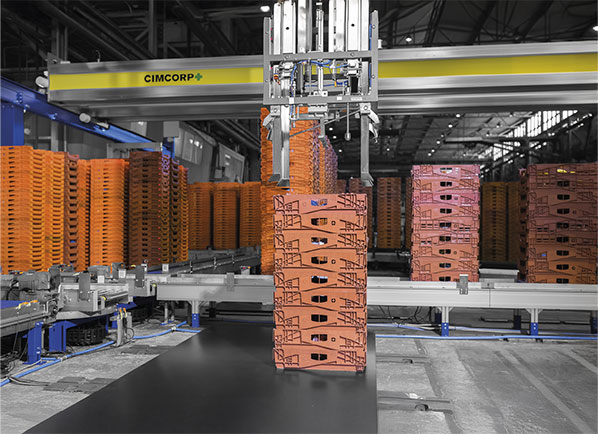
Modular automation is reshaping how manufacturers and warehouse operators approach system design – offering a strategic way to manage volatility, labour pressures and the rising need for flexible, efficient operations.
Unlike traditional automation systems that often require large-scale redesigns to accommodate change, modular automation is built around adaptability. It allows businesses to deploy discrete, compatible units that can be reconfigured, expanded or upgraded over time. This means automation can be scaled as needed, aligning investment with operational demand and future growth.
“Agility is the foundation of resilience in a world that never stands still,” says Riku Puska, sales manager, W&D industry sales at Cimcorp Group. “Traditional systems tend to lock companies into fixed processes, which makes adaptation slow and costly. Modular automation, by contrast, allows companies to stay responsive and competitive without overcommitting.”
Ongoing supply chain disruption, changing consumer behaviour and labour shortages are forcing companies to find smarter, more agile ways of working. Modular automation offers a solution that grows with the business, reducing upfront costs while supporting continuous improvement.
The competitive advantage of modularity
One of modular automation’s greatest strengths is its scalability. Instead of building a comprehensive system from day one, businesses can start small – automating high-impact areas first – and then expand over time. This staged approach makes automation more accessible and less risky, particularly for fast-moving sectors.
Flexibility is another key benefit. Modular systems can adjust to meet a wide range of operational needs, from adding capacity during seasonal surges to reconfiguring workflows for new product lines. This ability to pivot quickly can be a major advantage in industries where speed and adaptability are essential.
Efficiency is also central. Modular automation supports streamlined material flow and process optimisation, resulting in faster throughput, fewer errors, and reduced waste. Businesses benefit from improved order accuracy, shorter lead times and lower operational costs – all while maintaining system uptime.
Just as critically, modular solutions support long-term resilience. As technology evolves, new tools and systems can be integrated without having to rebuild from scratch. This future-ready architecture ensures that companies stay current without sacrificing prior investment.
“At Cimcorp, we believe automation should be as dynamic as the industries it serves,” says Jarno Honkanen, vice president, solutions & technology. “With Dream Factory for tyre manufacturing and Dreamfield for grocery retail, we deliver modular systems that evolve with our customers’ needs. It’s about giving businesses control and flexibility, not locking them into outdated infrastructure.”
Industry-ready use cases
In grocery retail, modular automation makes it possible to respond to shifting demand patterns with minimal disruption. During peak periods, additional modules can be deployed to increase picking speed and throughput – helping retailers maintain service levels without relying on excess labour. The result is a faster, more scalable fulfilment model that keeps up with consumer expectations.
In tyre manufacturing, modular automation enhances efficiency by optimising material flow between production stages. Systems can be expanded or adjusted as output requirements change, enabling manufacturers to respond quickly to shifts in product mix, order volume or global supply trends.
This ability to modify and grow automation on the fly reduces downtime, improves asset utilisation and builds greater resilience into production systems. Whether it’s handling sudden spikes in demand or gradually expanding capacity over several years, modular infrastructure provides a flexible path forward.
Where modular automation is headed
The next evolution of modular automation will likely be driven by AI, sustainability, and increasingly data-rich environments.
According to Puska, artificial intelligence is poised to make systems even more dynamic – analysing operational data in real time, making predictive adjustments, and autonomously refining performance.
“AI will bring a new level of responsiveness to automation,” he says. “By understanding patterns in demand, workflow and system output, we can build environments that self-optimise. That kind of intelligence is a game-changer.”
Sustainability is also taking centre stage. Modular systems are being designed with energy efficiency in mind – reducing power consumption, limiting waste and minimising footprint. This aligns automation with broader ESG goals, allowing businesses to improve performance while lowering environmental impact.
For businesses across warehousing, manufacturing and logistics, the modular approach offers more than just efficiency. It’s a strategy for managing uncertainty, controlling costs and building long-term capability.
“Automation is no longer about locking in a system for the next decade,” says Puska. “It’s about designing for constant refinement – upgrading with purpose, responding to change and always improving. In that sense, modularity is the smartest way forward.”