
Slow economy impacts KiwiRail as it repositions for growth
A national freight downturn in a soft domestic economy, and a series of one-off events, contributed to a fall in KiwiRail’s bottom line in the half year to December 31, 2024. However, good progress was made in delivering on the company’s transformation plan and investments which together are positioning KiwiRail for future growth.
KiwiRail recorded an operating surplus of $25.8 million for the half year, $14.7 million behind the same period last year. On top of the challenging commercial environment, one-off impacts included losing freight volume as a result of the closure of Winstone Pulp International (WPI), the Tawhai tunnel collapse, a delayed start to re-opening the North Auckland Line which was damaged by Cyclone Gabrielle and redundancies as the company better aligned itself to the markets it serves.
“As a key part of New Zealand’s supply chain, KiwiRail quickly feels the impact of any economic downturn,” KiwiRail acting chair Rob Jager says.
“Overall, rail freight net tonne kilometres were down 7% over the half year, consistent with the general freight market reduction of 7 – 10%. Normalising for one-off events, KiwiRail’s freight volume was down 2 – 3%.
“However, we are working hard internally and with customers to improve our service levels and to ensure that when confidence returns to the economy, we are in a position to attract more freight to rail. The reinstatement of the North Auckland Line after Cyclone Gabrielle and Fonterra’s return to rail, the steady long-term demand outlook for dairy and forestry, and the reinstatement of Tawhai tunnel and resumption of the coal programme are all positive.”
After losing volume with the closure of WPI, KiwiRail worked with logging operator Ernslaw One and other parties on a transport solution that was sustainable for Ernslaw One, KiwiRail and Rangitikei District Council. As a result, Ernslaw One is now moving its logs to Port of Napier by rail, instead of by road, unlocking the safety and road maintenance cost benefits of rail for regional ratepayers.
The company’s partnership with Coca-Cola, its fourth largest domestic customer, to design and deliver a rail siding extension at its Mt Wellington Distribution Centre enables a reduction of up to 7000 truck movements per year through Central Auckland and North Island highway. This, says KiwiRail, unlocks sustainability, safety, congestion and road maintenance benefits on these corridors.
KiwiRail chief executive Peter Reidy says that throughout HY25, KiwiRail helped its customers deliver through a tough period. The company also focused on its multi-year transformation programme to reshape KiwiRail so it increases productivity, and better meets the needs of customers and the expectations of shareholders.
“KiwiRail will grow by winning customer loyalty. That means delivering consistent superior customer service and improving operational excellence so we can be more competitive in the market. Our transformation initiatives are happening all across the company and saved $20 million in the six months to 31 December. We are committed to maintaining the momentum and achieving ongoing savings.
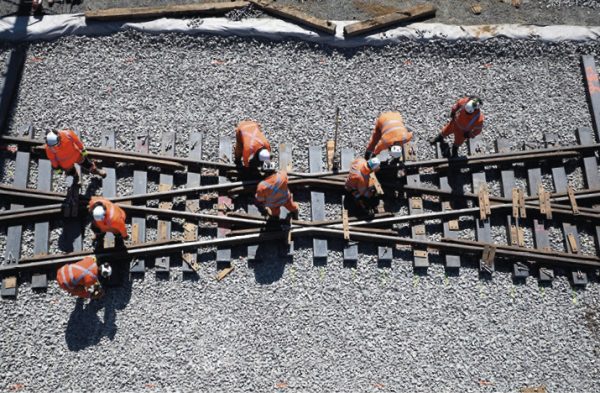
“In the half year, we forged ahead in safely delivering on Crown investment in infrastructure from which New Zealanders, customers and the economy, will ultimately benefit. I am particularly proud that the massive amount of work that is improving the rail network, is being delivered with our safety record improving all the time. In HY25 we have seen an 11% improvement in our total recordable injury frequency rate. High-Potential critical near miss events, which are an indicator of severe safety risks, improved by 14% compared with this time last year. We are on track to meet our year-end targets for both.
“Nothing is more important to me than the safety of our teams and the public.
“It is heartening to be delivering new infrastructure and substantial upgrades to New Zealand’s rail freight and commuter networks. There is no getting around that much of the 3800km national freight network is old and has been under-funded for too long. But as we deliver on the recent investments, we will also harness the benefits for KiwiRail, our customers, and for New Zealand.
“For example, since 2017, more than $1.8 billion has been invested in the Auckland metro network alone – mostly to help prepare it for the opening of the transformational City Rail Link next year. We have just seen the successful re-opening of the line between Papakura and Pukekohe which has now been electrified so people in south Auckland can enjoy all the benefits of the metro network. In Auckland and Wellington, people made 12.8 million trips on the metro rail networks. Even people who do not take the train benefit from all those trips being made by rail, instead of road.
“A third main line in Auckland to reduce congestion in this busy part of the network, improving flows for commuter, passenger and freight trains, will become operational this year.
“It is pleasing to see Interislander building back to strong volumes by lifting its reliability, with ships operating at almost 100 per cent reliability (excluding disruptions caused by weather) since the return of Kaitaki from deep maintenance in October. December passenger numbers in excess of 90,000 reflect strong private vehicle volume share during HY25. In December, we carried around 33,000 vehicles which was near our all-time high for this period. Aratere is scheduled to go to dry dock this year, continuing the enhanced maintenance programme to which KiwiRail is committed for the Interislander fleet.
“Bookings for our famous tourism trains are strong for summer after a subdued winter period with revenue up 20 per cent on the same time last year.
“Infrastructural improvements on the rail network, alongside a rejuvenation of our rolling stock including the first of 66 new locomotives arriving, and new wagons rolling out of the Hillside workshops, sets us up well to deliver an improved performance for our freight customers.
“Reducing carbon emissions is also increasingly important to our customers – whether it’s rail commuters in Auckland or Wellington, or a major exporter moving thousands of tonnes of freight by rail to reduce the carbon footprint of their supply chain.
“Moving a tonne of freight by rail on average produces around 70% fewer greenhouse gas emissions than moving it by truck. In addition to rail’s carbon advantage, across KiwiRail we are improving our environmental sustainability through a variety of measures including reducing fuel burn.”
In the six months to December 31, rail freight volumes of 1.6 billion net tonne kilometres resulted in 105,000 fewer tonnes of CO2 emissions, a 39.4 million litre fuel saving and less congestion and wear and tear on the roads than if that same freight had moved by truck. It also contributed to incremental GDP outputs. The total value of rail to New Zealand’s economy is estimated at $3.3 billion a year.
Reidy says, “I am confident that KiwiRail is well-placed to make the most of the economic growth to come, and to contribute to it by delivering more value to our customers and to New Zealand.”
Columbia Shipmanagement and Hamburg based shipping group RHL Reederei Hamburger Lloyd are just two shipping companies that have been using CMT´s Vibration Meter Marine since the product was unveiled in 2015.
“These ship managers wanted a monitoring system capable of immediate analysis of existing problems without requiring the user to have any special knowledge,” says Winkler. “Regular use of the system has alerted crews to bearing defects before breakdown, averting costly damages. The technology has already justified the investment.”
Vibration analysis provides insights into the most common cause of machinery damage and reduced service life. Bearing damage is particularly prevalent, caused by shaft misalignment, insufficient or incorrect lubrication and general wear and tear. Pump health can be easily assessed by analysing vibration.
“Crews of seagoing vessels are under constant stress, and crew changes occur at fixed intervals, so vibration monitoring devices need to be easy to use with measurement readings that are simple to understand by crew members with limited technical knowledge.
“Our Vibration Meter Marine is a powerful, expert system that provides on-the-spot usable results without the need to send information to shore for evaluation. Even beginners can understand what the readings are telling them,”says Winkler.
Alongside a range of vibration meters, monitors, software and analytical tools, the CMT´s Vibration Meter Marine has been specifically designed for the harsh marine environment. The hand-held device, acceleration sensor, software, and accessories are delivered in a small, rugged case designed for easy storage in between usage.
The meter also includes a mode to monitor the lubricating performance of greased, water, or oil lubricated bearings in pumps and rotating machinery. As an option, data can be stored for trend analysis using the diagnostic software.
“Our goal is to provide crews and superintendents with a practical solution that will enable them to detect pump problems early and shift from fixed inspection schedules to more effective condition-based protocols. Vibration analysis does need to be part of the regular machinery checks crews make on their rounds.”