
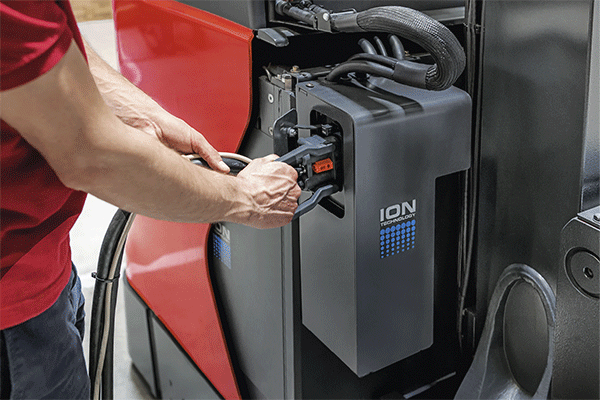
There is a growing interest in, and the uptake of, lithium-ion batteries for industrial, warehouse and distribution centre equipment and machinery. However, there is still widespread confusion and misunderstanding about the battery technology. Here, LDX territory manager Stewart Russell – distributor for Linde Material Handling equipment in New Zealand – “dispels these myths” and highlights the advantages of lithium-ion batteries.
WE DO A LOT OF HEAVY LIFTING AND BATTERY ELECTRIC MACHINES JUST WON’T CUT IT
Lifting capacity is not an issue with modern battery-powered equipment. If the capacity plate ratings are the same as the equivalent internal combustion engine model, so is the ability to lift heavier loads.
Linde motors and control electronics have the highest performance capabilities, ensuring minimal power loss and maximum energy efficiency.
YOU CAN SWAP A LEAD-ACID BATTERY FOR A LITHIUM-ION BATTERY TO REAP ALL THE BENEFITS
Sure, but there is work required within the operating system of the truck. Aftermarket lithium-ion batteries are a massive improvement on their lead-acid equivalents, but to enjoy the real benefits, you should consider factory-fitted OEM lithium-ion batteries which have inherent advantages.
For example, integrated batteries feature CAN bus connectivity, meaning the truck’s factory BDI still works accurately, and the OEM technicians can connect to the battery and diagnose any issues via the truck software, eliminating the need to call in a third-party provider.
LITHIUM-ION BATTERIES ARE PROHIBITIVELY EXPENSIVE
It is important to take a long-term view of costs. Although the initial purchase price of lithium-ion batteries is higher than lead-acid batteries, they have a lower cost per cycle due to their increased lifetime, making them the most cost-effective solution in the long run.
WE WOULD NEED TO REPLACE OUR WHOLE LEAD-ACID FLEET WITH LITHIUM-ION MACHINES
Certainly, it often makes sense to replace the entire fleet so that operators don’t have to switch between different charging regimes and operating procedures. It also makes sense with an ageing fleet, where there is a decision to retire all existing machines and start again.
But a blended fleet is possible if some trucks are not utilised enough to warrant the investment in lithium-ion batteries and we’ve assisted many customers with staged rollouts.
OUR POWER SUPPLY WOULD HAVE TO BE UPGRADED
Yes, chargers for lithium-ion batteries have a higher output, which means they require a higher input current compared to lead-acid chargers. However, Linde has various battery/charger combinations available depending on the utilisation, application intensity, and available charging windows.
For instance, a small or medium-sized charger may be used with existing power points, which means peak power draws may be only marginally above that of existing lead-acid chargers.
DRIVERS WOULD HAVE TO BE RETRAINED AND CHANGE THEIR WORK HABITS
There will be a need for retraining, as standards require each user should have policies for safe systems of work with supervised practice, on-the-job training, and ongoing regular refresher training.
The good news is that lithium-ion batteries are easy to use for the following reasons:
• The battery management system talks to the charger to prevent overcharging.
• It manages power delivery to prevent over-discharge.
• It requires no watering or equalise charging.
• The operator must simply know how to plug it into the charger when not in use.
LITHIUM-ION BATTERIES ARE NOT AS STABLE AS LEAD-ACID AND REPRESENT A SAFETY THREAT
This is a common myth, but in reality, lithium-ion batteries are much safer than conventional lead-acid batteries. Even though they have a higher energy density than lead-acid batteries, Linde lithium-ion batteries have a multi-level safety system at cell, module, and housing levels, alongside a battery management system (BMS) with comprehensive protective functions.
LITHIUM-ION BATTERIES DON’T LAST AS LONG AS LEAD-ACID BATTERIES
Lithium-ion batteries have a longer cycle life, allowing them to be used effectively in applications with sufficient charging opportunities. Because lithium-ion electrochemistry has higher energy density and voltage stability, and less inner resistance, it leads to higher power output, increased efficiency, and fast charging capabilities.
LITHIUM-ION BATTERIES ARE NOT SUITED TO HARSH ENVIRONMENTS
Through extensive testing, we’ve found that lithium-ion batteries tend to outperform lead-acid batteries in rough surface environments, high-usage environments, low temperatures, and most other environments where lead-acid batteries would have struggled or not performed at all.
Linde supplies datasheets and user manuals for each type, which specify the exact operating conditions.
LITHIUM-ION BATTERIES POSE A SERIOUS ENVIRONMENTAL THREAT AT THE END OF THEIR LIFE
Despite their long service life, even lithium-ion batteries reach the end of their performance at some point, which is why lithium-ion battery recycling centres are popping up across the globe. This means that batteries can be returned to Linde network service partners. They are then sent to a certified recycling company, with which Linde has set up a comprehensive recycling process for its lithium-ion batteries.