
Asics overhauls warehouse automation strategy
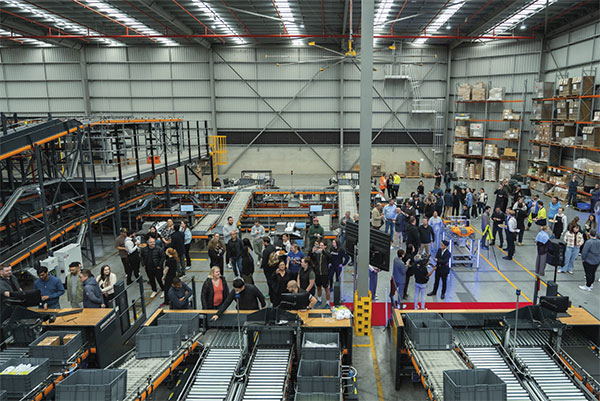
Asics has transformed its Australian distribution operations at its Marsden Park facility in Sydney, saying significant productivity gains have been delivered through the implementation of advanced automation technology.
The project, named Kakushin – a Japanese term meaning innovative transformation – was delivered in partnership with automation specialist Vanderlande and supply chain consultancy ThreeSixty Supply Chain Group. The project has been recognised by the supply chain sector, winning the Supply Chain Management award at the 2025 ASCLA awards held at Melbourne’s Town Hall late last month.
Asics says the transformation was driven by its shift from a predominantly wholesale distribution model to one increasingly characterised by smaller consumer and e-commerce orders. This change required a fundamental redesign of warehousing processes to efficiently handle higher volumes of multi-item orders associated with modern retail fulfilment.
According to the project partners, a key differentiator was the integrated omnichannel approach adopted at Marsden Park. The solution supports e-commerce, store replenishment and wholesale operations within a single, unified system. Unlike many goods-to-person solutions focused solely on e-commerce, or standalone cross-dock sorters, the Asics operation integrates multiple technologies into a single end-to-end workflow.
During the transformation, the project team encountered several technical challenges, including fire service compliance issues and the discovery that the warehouse slab did not meet automation load specifications. These constraints prompted a change in system design, with the original mini-load crane concept replaced by high dynamic storage (HDS) shuttle technology. This marked the first implementation of HDS technology of its kind in Australia.
The revised approach addressed structural weight limitations while delivering higher-than-required performance levels. The HDS buffer system also resolved operational constraints associated with limited dock capacity, providing additional space and sequencing capability for palletising and dispatch activities.
“At our NSW Marsden Park facility, the new automation system has significantly increased processing capacity and efficiency, with room for future growth,” says Michael Masulans, director, general manager finance and administration, Asics Oceania.
“Strong collaboration played a huge role in the success of this project. ThreeSixty’s industry knowledge and expertise enabled us to transform high-level ideas into concrete implementation plans. Their involvement was invaluable throughout the entire process, from developing the business case to managing the complex operational requirements during delivery. Vanderlande’s on-site management and their willingness to adapt their solutions to our specific requirements set them apart. Their Adapto goods-to-person (GTP) solution and HDS case buffer technology was tailored specifically to our needs, setting our supply chain up for years to come,” says Masulans.
The project was delivered over two and a half years without disrupting customer service. Asics maintained full operational capability throughout construction, compressing approximately one-third of its warehouse operations while installation works proceeded. This required close coordination between multiple contractors, electricians and fire safety specialists within a live warehouse environment.
Asics and ThreeSixty also implemented detailed advance planning processes, including 3D design workshops conducted across multiple time zones to ensure clarity around equipment placement and system integration.
“We put aside nearly three or four months for end-to-end testing, and it’s one of the best go-lives I’ve seen from a software perspective. Asics leveraged ThreeSixty and Vanderlande’s strengths to achieve the goal of not disrupting customer service levels while processing live orders, product testing, and hundreds of test scripts. Software issues can plague these kind of automation projects, but we had the right WMS partner, the right IT project managers, and the right IT resources to ensure the software integration was seamless,” says Derek Tan, executive director ThreeSixty.
“When we were presented with structural weight limitations and throughput requirements, our engineering team worked closely with Asics to find the right solution. The pivot from mini-load to high dynamic storage technology not only resolved the immediate challenges but delivered performance that exceeded the original specifications. This project shows how close collaboration and flexibility can turn constraints into advantages,” says Roald De Groot, sales director Vanderlande.
The Kakushin project has positioned Asics for future expansion, with capacity to add further pick and pack stations and potential AGV capability. The company says the solution provides a scalable platform supporting operations through 2030 and beyond, while also delivering environmental benefits through reduced packaging waste and more efficient container loading.