

Autonomous, zero-emission heavy goods vehicle
Fusion Processing Ltd has announced a consortium project, Hub2Hub, that has awarded £6.6 million to develop and deliver what the company describes as a ‘revolutionary, world-first, autonomous zero-emission HGV’ for the UK market.
Accelerating towards the next generation of transportation and logistics, the Hub2Hub consortium will create a self-driving heavy goods tractor unit, which will begin road trials in 2024, with major UK retailer, ASDA, overlooking the vehicle development as strategic partners.
The £12 million venture has been selected by the Centre for Connected Autonomous Vehicles (CCAV) as one of seven recipients for its joint industry and government-funding. The Hub2Hub will showcase the potential of autonomy in the transportation sector with unprecedented levels of efficiency, safety and operational cost savings for logistics operators, as well as providing new employment opportunities.
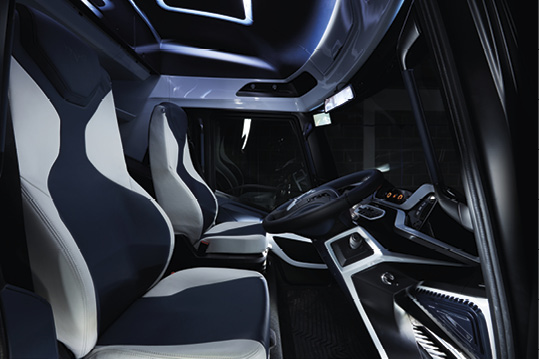
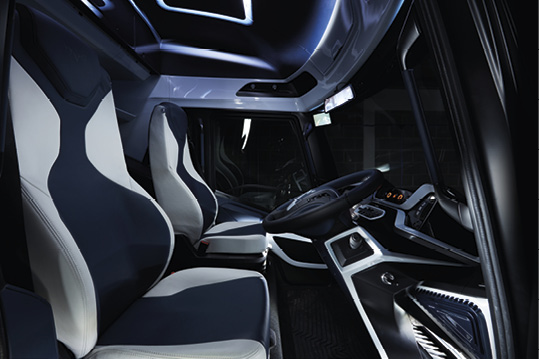
The consortium, led by HVS, includes Fusion Processing Ltd, and ASDA, will build two prototype vehicles The first hydrogen-electric HGV prototype will be fitted with a driver’s cab and tested on the road in autonomous operation, using the Fusion Processing Ltd’s automated drive system, CAVStar, with a human safety driver at the wheel.
The second prototype will have the driver’s cab removed and replaced by an aerodynamic fairing. During the project this vehicle will be evaluated on test tracks, with the CAVStar system in this application allowing a remote human driver, located in a control hub, to operate the vehicle.
Together these two prototypes point to an optimised future logistics system where vehicles could be operated in autonomous mode on a hub-to-hub route, with a remote driver then taking control to drive the vehicle from the hub to its end destination.
Not only will HVS’ innovative HGV decarbonise one of the biggest polluting vehicle sectors on the road, says Fusion Processing, it will expedite the development of Hub-to-Hub automated driving technology.
Autonomous, self-driving vehicles have the potential to revolutionise haulage and logistics sectors, particularly the long-haul, heavy-duty goods vehicle market.
Through the integration of ground-breaking sensor technology within the vehicle consisting of an array of radars, LIDARs, cameras, and artificial intelligence, it provides unprecedented operational safety without human intervention.
The application of this advanced system offers a next-generation solution to today’s shortcomings in the haulage industry, namely solving issues of driver shortages and improvement in driver quality of life, thanks to remote tele-operated vehicles. Drivers can stay local as well as take advantage of less intensive driving shifts, for a greater work-life balance.
Fleet operators can also benefit by optimising vehicle utilisation during less busy hours, thereby making logistics more efficient and more environmentally friendly by avoiding congestion. In addition, on-board advanced automated drive systems can reduce energy and tyre emissions by optimising acceleration and braking at a far greater level than human ability.
Improved operational efficiencies will help create and support new business models by providing never-before-seen freedoms of transport logistics and reductions in vehicle TCO. “The automated haulage depots and hubs used for autonomous vehicle technology will also offer improved usage of space, safety and efficiency for operators,” says the company.

You must be logged in to post a comment.