
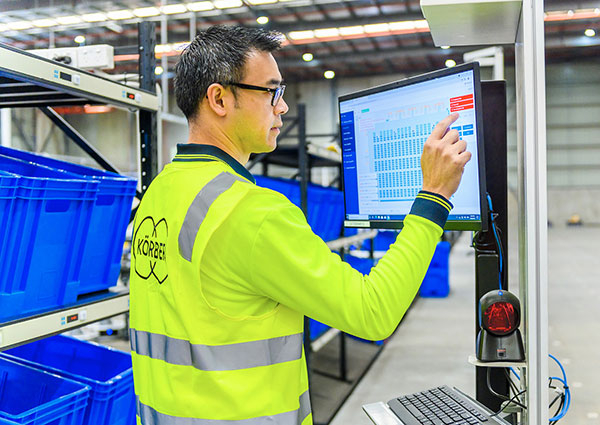
HOW TO ATTRACT, RETAIN AND UPSKILL YOUR WORKFORCE
As the labour market tightens, demand for supply chain and tech talent is at an all-time high. With the skills shortage posing a major threat to an organisation’s resilience, efficiency and profitability, Körber Supply Chain takes a deep dive into what’s driving the labour shortage and how businesses can better retain, attract and upskill their workforce.
Job ads in New Zealand are at a record high, and according to online employment marketplace provider Seek, attracting talent is the greatest challenge New Zealand businesses face today.
Furthermore, the recent New Zealand Institute of Economic Research (NZIER) Quarterly Survey of Business Opinion revealed that firms are finding it very hard to recruit in today’s climate, and the majority of respondents cited lack of labour as the biggest constraint to growing their business.
According to Anthony Beavis, managing director at Körber Supply Chain ANZ, in the supply chain and retail sectors, the pursuit of customer satisfaction and efficiency is the driving force for many businesses, and as a result sourcing and retaining labour has become increasingly challenging.
Not only is there a worldwide shortage of staff, but it is also difficult to attract workers into a warehouse environment that can be both physically demanding and dangerous.
Combine this with low pay and the constant pressure for efficiency and consumer satisfaction, and you have a perfect storm of worker disinterest and dissatisfaction.
Yet despite its challenges, the skills shortage presents an opportunity to redefine the way we work, including the way we value our employees.
Overcoming challenges with advanced technology
Against these challenges, technology offers a solution, unlocking new operational savings while supporting employees to work more safely, enthusiastically, and productively.
Introducing the right technology, in the right place, and connecting it with the workforce and the warehouse system, will enable organisations to build the supply chains needed for the future.
With warehouse managers under increasing pressure, they now must find, train and engage staff to manage the demands of growing customer expectations, expanding product lines and unexpected peaks.
Today, Körber customers around the world are leveraging the benefits of advanced technology to improve efficiency and productivity and increase employee safety and engagement.
Empowering employees with voice picking technology
One agile and flexible solution is voice-directed work (VDW). The popular Android Voice solutions guide employees with online and instore order fulfilment – improving productivity, reducing errors and safety incidents, as well as decreasing training time.
By blocking out the noise of the warehouse and streamlining worker activities, VDW can improve accuracy, productivity, and safety across various functions in the warehouse including picking, putaway, replenishment, cycle counting, receiving, inspection and line loading.
Voice technology is intuitive – it can adapt to unique user language inflections. This means it can significantly reduce training time, disruption to operations, and associated costs. Seasonal or temporary workers can be trained in a matter of hours, rather than the 2–3 weeks required with traditional methods.
Boosting efficiency with agile automation
A further opportunity to tackle labour challenges with technology is the use of Automated Mobile Robots (AMRs).
Equipped with a combination of sensors, vision systems, and sophisticated mapping software that allows AMRs to respond in real time to changes in the environment, these robots can move independently around the warehouse, avoiding people and objects.
Many are fitted with screens that help assist warehouse workers, with details of what needs to be picked or put away. Ideal for scaling up and scaling down, they help organisations rapidly meet peak demands and can move goods more efficiently around the warehouse than traditional picking methods.
They also reduce the steps and movement that warehouse staff have to make, which not only improves productivity but reduces the risks of slips and falls, repetitive strain injuries and fatigue or fatigue-related accidents.
Where technology meets humanity
Rather than be a cause for conflict, technology can be used to fulfil the needs of both the customer and the employee. With careful planning and consideration, the introduction of selected technologies can be a cost-effective way to improve product quality and choice, while simultaneously driving safety, productivity, and worker engagement.
“Any solution needs to match the scale of your operation, and offer benefits from both a safety and an efficiency perspective, encompassing the requirements of both your business and your workforce. At Körber, we look at technology with a much wider lens and as such it has been great to deliver some further benefits for our customers around sustainability, employee wellbeing and occupational health and safety,” Beavis says.
Finding the right solution
Whether an organisation needs to respond to peak demand or manage crises, increase employee awareness and social distance, expand product lines, or adapt to new regulations – technology is available to support.
However, whatever technology is deployed, labour will always remain the cornerstone of any operation. “Using technology as a tool to augment and support employees to do their jobs better, is the secret to keeping them safe and on side,” says Beavis.